Originally written in French. Translated by AI — the meaning has been preserved, not the prose.
From the cost of specification to knowledge capital, in the age of agentic development.
A few days ago, I was talking to another Product Manager about how I develop with artificial intelligence. Somewhere in the conversation, I told him something that probably surprised him a little: I hardly write specifications any more. Most of the time, I don't even go through a tool like OpenSpec.
The reaction is fairly predictable. How can you build a serious product without specifying precisely what it has to do? What about business rules, edge cases, acceptance criteria, regression risks? How do you make sure the AI has understood what you expect of it?
These objections are legitimate. But they often rest on a confusion between things that have neither the same nature, nor the same value, nor the same lifespan. I am not suggesting we stop specifying business rules. On that point, I am in fact uncompromising. What I am questioning is the time we spend specifying every use, every screen, every interaction, including when there is nothing new about them.
Since I started developing regularly with AI agents, I have been wondering whether we are still applying a way of working designed for an economy that is changing.
1. Specification had an economic reason
For a long time, development time was a scarce resource. A team had limited capacity, features piled up in a backlog, and a misinterpretation could cost several days of work. Having something built that turned out not to be what you wanted was a poor use of that capacity.
So it was rational to try to reduce uncertainty before development. The PM wrote a specification, detailed the user journeys, prepared mockups with a designer, wrote acceptance criteria. We reviewed, clarified, estimated, and then the developer started work. We were trying to spend time thinking in order to save time building.
I am not criticising that logic. It fitted the constraints of the time perfectly, and I practised it for decades. But we sometimes forgot that the specification itself had a cost.
You have to understand what the user wants, imagine how the product will behave, represent the screens, write up the special cases, pass that knowledge on, answer questions, review changes to the specification, then maintain the documents when the product changes. A PM can spend two hours describing a perfectly ordinary feature in precise detail. That time does not seem excessive if development will take one person two or three days. It becomes much harder to justify if an AI agent can build the feature (and five others in parallel), test it and make the first fixes while the PM works on something else.
Lower production costs do not mean every feature has become free. The code will have to be maintained, the decisions will have to be owned, and a mistake can still have expensive consequences. But for some features, the ratio between the cost of describing and the cost of building changes radically.
Take a screen for managing VAT rates in an ERP. The rate has a business definition, constraints and relationships with invoicing operations. That deserves our full attention. But the screen used to view the list of rates, add one and choose a default rate is not necessarily what sets this ERP apart from its competitors.
If the rules are already known, the components available and the product's conventions established, do I still need to describe where every button goes, how the form is laid out and all the usual behaviours of a list? Or can I ask the AI to build the screen, then use it and fix what needs fixing?
That is the economic question I am asking. The right level of specification is not necessarily the one that minimises the risk of having to change a first implementation. It is the one that minimises the total cost of getting the right result, given the risk you are prepared to accept.
There is another consequence of this shift in costs. Development can become a tool for thinking. However well you imagine a user journey in a specification, actually having it in front of you, interacting with it and handling real data changes how you understand it. You discover details whose importance you had not seen.
That is already why we moved from static mockups to clickable ones. In many cases, I think we can now go one step further: develop directly. That does not make mockups useless. For a new kind of interaction, a particularly strategic screen or a design exploration, a mockup is sometimes still the best way to think. But it should no longer be a mandatory step for every screen.
2. Business rules are not uses
When I explain that I specify much less, people often reply that some domains involve extremely precise rules. I completely agree. But business rules and uses are not the same thing.
Domain-Driven Design (DDD) offers a particularly useful framework for understanding this distinction. In an architecture inspired by it, the domain carries the business concepts, entities, value objects, behaviours and invariants. The application layer orchestrates the use cases. The interface offers a way of interacting with the system.
The same business object can be handled from several screens, a mobile app, a web client, an API or an AI agent. You can offer several journeys to carry out the same operation. You can change those journeys without changing the nature of the object or the rules that govern its behaviour.
This is precisely one of the reasons I work on product ontology. In I wrote a product's ontology. Three times, I thought I was done., I explained the value of making explicit what the product actually handles. In Ontology-Driven Design, I described how that knowledge can act as a safeguard when developing with AI.
Imagine a process that requires a financial sign-off and a legal sign-off. The fact that an operation cannot be approved until both sign-offs have been obtained belongs to the business domain. It should not be possible to get round that rule by using another interface or another journey.
A sign-off policy can be modelled as a value object when it is defined by its values and has no identity of its own. An individual approval may, depending on the model chosen, be an entity if its identity and life cycle matter. The invariant, for its part, must be guaranteed by the domain. How those approvals are shown on screen is another matter. As for the order of the sign-offs, it can be left open only if the business itself does not impose a sequence.
On invariants, I am not in favour of compromise. You have to define the concepts, understand their relationships, specify the permitted and forbidden behaviours, write edge-case tests and, where relevant (which, in my view, means all the time), use mutation testing. Mutation testing introduces changes into the code to check that the tests actually detect changes in behaviour. High test coverage is not, on its own, proof that the right rules have been tested.
These requirements matter all the more when several agents may work on the code. They make the constraints every change has to comply with verifiable.
That does not mean all uses are secondary. Some screens embody precisely what the product is worth. That is where a fine understanding of the business, an original way of solving a problem or an edge over the competition takes shape. For these differentiating uses, I want to invest time in specification, in needs analysis and in experimentation. I want to understand why one solution is better, keep a record of the decisions and build up the knowledge gained.
So I will not treat a standard screen and a screen that carries the heart of the value proposition the same way. Technical complexity is not always a good indicator of their relative importance, either. A screen that is relatively simple to code can be a decisive innovation for users. Conversely, a technically demanding feature can be a commodity expected in every product on the market.
The question is what rigour should be applied to, and why.
3. Specifying: capital or expense?
This brings me to what I see as the heart of the matter. Not all specifications hold their value over time.
Meticulously specifying an ordinary screen is, more often than not, a one-off expense. That expense may be necessary, but its immediate benefit is mainly that this screen gets built. For the next one, we are likely to start again.
Specifying an ontology, a business policy, an architecture rule or a design system is, on the contrary, an investment. We are building capital we will benefit from throughout the product's life.
The distinction is not absolute: a screen specification can contain reusable knowledge, and a badly designed design system may never be used. What interests me is precisely identifying what deserves to be pulled out of a one-off request and added to the product's shared knowledge.
| One-off specification | Knowledge worth building up |
|---|---|
| Describing a standard form | Defining the components and how they are used |
| Repeating a constraint across several requests | Formalising an invariant in the domain |
| Describing every behaviour of a list | Setting the conventions for handling lists |
| Explaining the business vocabulary yet again | Maintaining a shared ontology |
| Asking an agent for the same fix again and again | Identifying and dealing with the common cause |
AI changes the potential return on that investment. It can draw, every time it builds something, on knowledge already present in the context, provided that knowledge is accessible, understandable and maintained. I no longer have to repeat in every request things the system already knows.
The design system as knowledge capital
The design system is often associated with a component library, colours, typography and composition rules. That is necessary, but I want to go further.
A structured design system, drawing for example on Atomic Design, should let the agent know not only which components exist, but also when to use them, how to combine them and why certain conventions were chosen. It may be a basic component or a more complex assembly that embodies a recurring use.
Here is an example deliberately transposed from a real case, without identifying the product. A PM, analysing their product's usage data, finds that 95% of bookings are for the next three months. Instead of always showing a calendar that displays a single month, they decide that a component designed for this use will show the coming three months straight away. Other periods naturally remain accessible.
Once that decision has been incorporated into the design system, I can ask for a booking screen without explaining again why it should display those three months rather than the monthly calendar component. The AI identifies the right component, understands its behaviour and has what it needs to test it. Knowledge about users stops being locked away in a study, a conversation or a screen specification. It becomes a capability of the system.
You do, however, have to keep the provenance, the scope and the reasons for that decision. Nothing guarantees that uses will stay the same over time, or that the observation holds for every kind of booking. The code shows the behaviour chosen; the knowledge explains why it was chosen.
Learning by developing
Every time you fix something the agent has built, you have potentially learnt something. But a local fix is not automatically a new general rule.
To begin with, you could simply use a knowledge file, for example kb.md, to record certain feedback and lessons. The agent would find in it what it needs to avoid repeating the same mistakes. A more elaborate system could surface observations from data, user feedback and fixes, then propose changes to the existing knowledge.
You have to tell apart what is a preference specific to one screen, what is a reusable interface convention and what is a change to the domain. AI can help with this sorting. Decisions that change the shared framework, notably business rules and the design system, must nonetheless remain governed by humans. It is not for an agent to decide on its own that a local fix justifies changing every component in a product.
It is the same logic as in ontology-driven development: check the intent against existing knowledge, detect contradictions, decide whether the model needs to change, then incorporate that decision into the reusable knowledge.
In this way we can replace part of the repetitive documentation work with a system that learns. The aim is not to write less and less. The aim is not to have to write the same thing twice.
4. Development on autopilot
I am trying this approach out in practice on Malorean Notes, my personal note-taking app for Mac. It is a particularly interesting testing ground, because I work on it in my spare time and can hardly spend dozens of hours specifying every feature.
I started this project from scratch. So I was able to lay a number of foundations: an ontology, an architecture, file formats and development rules. I spent time defining certain specific objects, notably those of the CRM, as well as the formats that matter for the long-term durability of the data. I do not claim these foundations are perfect. This project is also a way for me to learn.
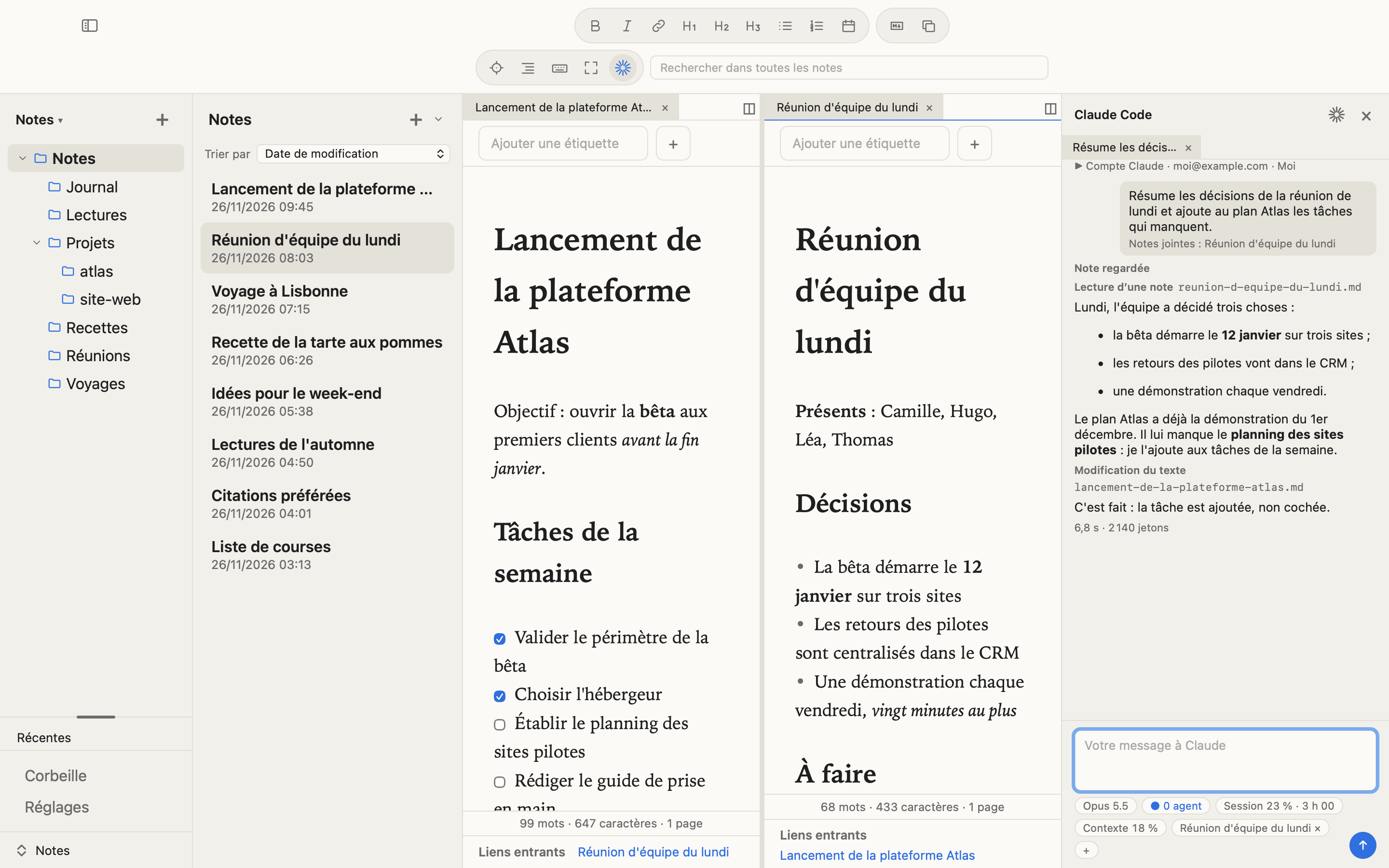
Malorean Notes: the note tree, two notes open side by side and, on the right, the column where you talk to Claude Code.
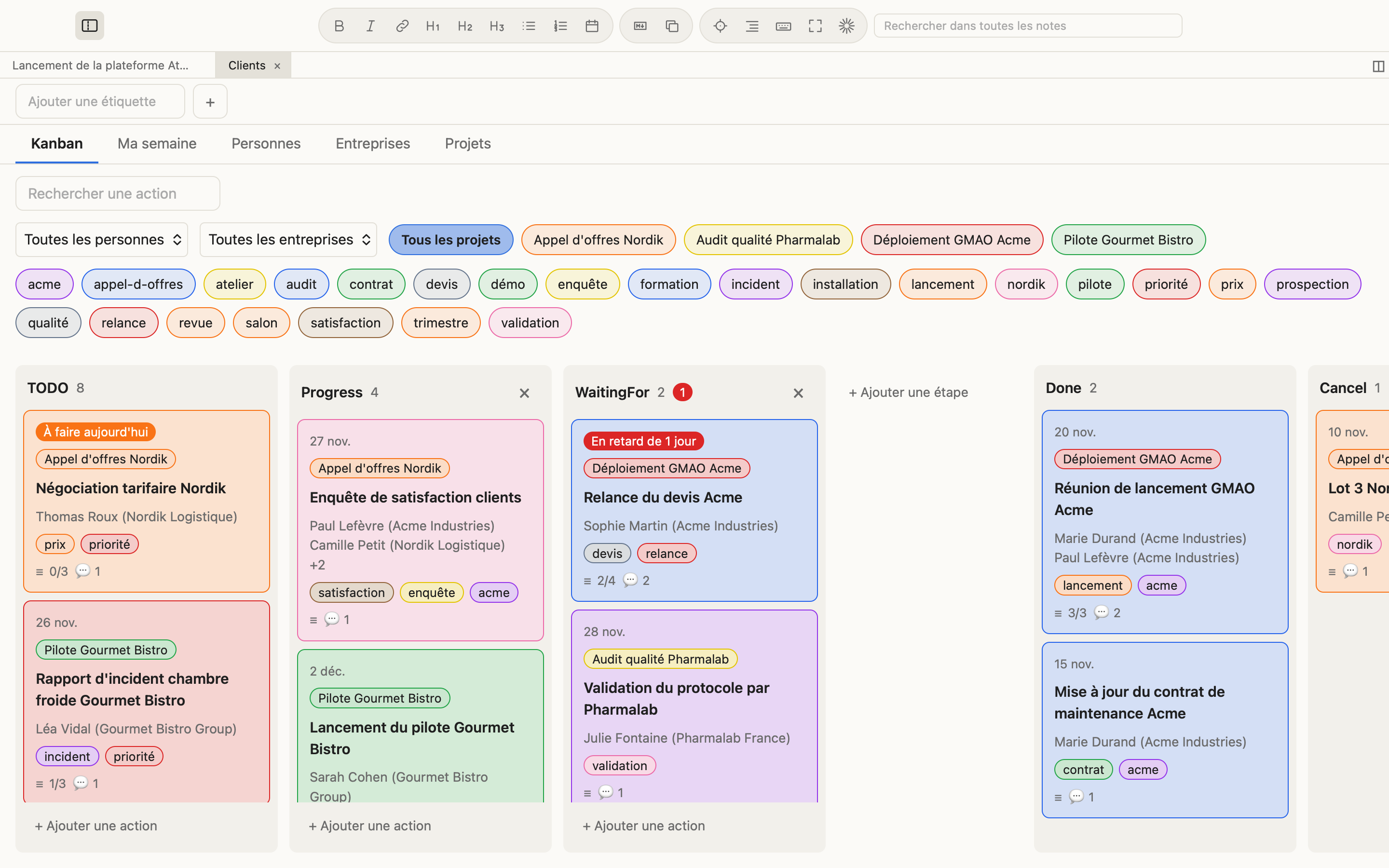
The CRM's Kanban view: actions are sorted by stage and linked to people, companies and projects.
On ordinary screens, I have adopted a different way of working. I build up a list of requests, often expressed in a few lines. I ask the AI to analyse them, raise the necessary questions, then develop the features. It can then work through the requests one after another, without my writing a detailed specification for each.
A request might look like: "Make me a screen for entering VAT rates and setting one as the default." In another case, I might say: "For the title bar, do it like Apple Notes", then attach a screenshot. That visual reference stands in for a description of the intent, without claiming to define every detail of the implementation.
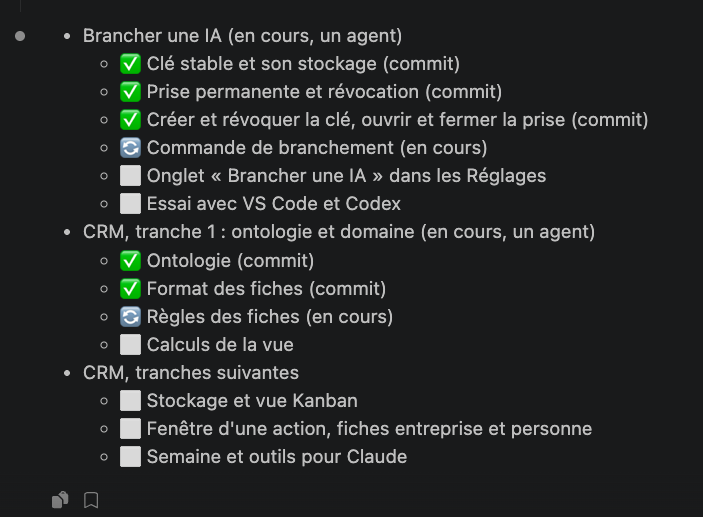
A list of requests in Malorean Notes: a few words per line, and the progress status of each (done, in progress, to do).
Once the features have been developed, I use them. I see that a given component should be somewhere else, that a given behaviour is not quite what I wanted, and I ask for a fix. In a great many cases, the ordinary interactions already work. When you add or remove a tag, for example, an agent that understands the objects being handled and the product's conventions can often deal with the usual cases without my writing an exhaustive list of acceptance criteria myself.
To give an order of magnitude, I think the specifications and feedback took me about ten hours of work with the AI, where I reckon I would have spent thirty to forty hours specifying those same features exhaustively with my old methods. These are retrospective estimates, not the results of a timed experiment or a generalisable productivity measure. I am comparing personal time spent working with the AI with a hypothetical specification time, not two strictly comparable full delivery cycles.
What is particularly instructive is the nature of the fixes I had to make. I had laid business and architectural foundations, but I had not yet built a real design system. A large share of my interventions therefore concerned the interface. With every new feature, I ran into the cost of shared knowledge that had not yet been sufficiently built up.
Analysis comes before execution
Autopilot does not mean sending a list of requests to an AI and handing it every decision.
Before coding, the agent has to analyse what it is being asked and check it against what already exists. Is there a contradiction with a business rule? A new concept? An architectural incompatibility? A component missing from the design system? An ambiguity that significantly changes the expected result?
If the analysis reveals a decision that goes beyond the scope of delegation, the agent has to ask the human and wait for a decision on that request. Other independent tasks can move forward if their analysis allows it. This principle matters: a request can be short while having an identifiable goal, and autonomy must rest on sufficient analysis, not on the line count of the request alone.
A concise request is therefore not a vague request. Even for an ordinary screen, you need a goal precise enough to determine what has to be delivered, and a framework that lets the agent find the constraints that have not been repeated. A feature is done when it meets that intent, follows the shared rules and passes the applicable checks. It is not done simply because the code compiles or because the tests produced by the same agent are green. Tests are partial technical proof; on their own, they do not prove that the business intent has been correctly understood.
The Malorean Notes repository shows how I structure that framework. The CLAUDE.md file points in particular to the ontology, the architecture, the formats, the validated specifications and the working rules. It defines a task queue, automated checks, how branches are used and when development stops for tasks that still need discussing. Validated specifications do exist: the question is their place in the process and how much detail they carry upfront.
The point is to put the AI in a position to work on its own when that makes sense. Several independent pieces of work can even be carried out in parallel on a single machine — two or three at most, a limit due to the Mac's power and not to the method — with separate working environments. That gain is only possible if the organisation of the code, the dependencies between tasks and the checks allow that autonomy.
5. Managing development by risk
An agent's autonomy does not mean every feature has to follow the same path to being merged.
Imagine three new read-only screens. If their development is independent, they reuse proven mechanisms and their risks are low, is it really necessary to run three separate cycles of human validation? Sometimes you can merge these changes and do a single grouped functional validation. A feature flag can make the screens unavailable if needed.
This is not a universal prescription to merge three features straight into the main branch. Even a read-only screen can expose data to people who should not have access to it, cause performance problems or present misleading information. And a feature flag repairs neither a data leak nor corruption that has already happened. Authorisation, security and regression checks are still needed.
If a feature changes an existing business process, persists essential data or carries out an operation that is hard to reverse, I prefer to take more precautions. You can test and merge the changes in isolation, tighten the checks and require a specific human validation. Invoicing and accounting in an ERP will not be treated like an internal information screen.
Fundamentally, we were already doing this before AI. When a team had limited QA capacity, it did not necessarily invest the same time in every module. It was rational to devote more human testing to financial operations than to interactions where mistakes were cheap and easy to reverse.
I am proposing to extend that logic to specification and to agentic development. The criticality of the data, reversibility, the impact on existing processes and the ability to verify behaviour should all help define the level of delegation and checking. How differentiating the feature is forms another axis: a strategic but easily reversible screen may need considerable design effort without requiring the same merge procedures as an accounting change.
To decide the level of specification and delegation, I would therefore separate two axes: the differentiating value of the use, and the risk of building it.
| Low risk | High risk | |
|---|---|---|
| Ordinary use | Concise request, autonomous development, proportionate validation | Concise request possible for the interface, but business constraints and thorough checks |
| Differentiating use | In-depth design, experimentation and capitalising on the choices made | In-depth design, explicit invariants, stronger checks and a controlled merge |
This grid is not a certification procedure. It keeps you from confusing the value of a use with the technical or business risk of building it. A standard feature that handles access rights can be riskier than an innovative interface that only displays public information.
Validation becomes the scarce resource
Increasing development capacity also moves the problem. If several agents are producing code at the same time, who reviews the pull requests? Who checks the results? Who writes the documentation and validates the changes?
You have to automate what can be automated. Tests, architectural checks, convention checks, interface scenarios and part of QA should not systematically require human intervention. The same goes for generating screenshots, documentation and, in some cases, explainer videos.
That automation must itself be checked. An agent that has misunderstood a rule can write a test that validates its mistake. Hence the value of invariants defined independently, regression tests, mutation checks and, for critical matters, verification separate from the work of the agent that produced the code.
Above all, there remains what no coverage indicator can decide for us: is the use relevant? Does this feature really improve the product? Is it worth the costs it will bring in the future? Have we chosen the right solution?
These questions are not just about QA. They are a matter of judgement and taste. It is a distinction you also find in Andrej Karpathy's talk at AI Ascent 2026, on the move from vibe coding to agentic engineering: being able to delegate execution does not relieve us of judging what is being built.
The ability to produce more has to serve impact. That was already a topic in discussions about AI and content production I took part in at Adobe Summit. Producing more for the sake of producing more is not a goal. A useless feature costs something even when it was very quick to develop: it enlarges the surface to maintain, explain, secure and understand.
So the PM does not become a mere operator feeding a queue of requests. Their responsibility for choosing what deserves to exist becomes even more important.
6. When the specification stops being a contract
The specification did not only have a descriptive function. It was also a de facto contract between the PM and the developer. The first described what they wanted; the second had to build it.
But what happens when a small interface fix can be made in a few minutes by an AI agent, while passing it from one person to another takes several steps?
The PM spots a problem, writes a message to the developer, who rephrases the request for their agent, generates a new version, makes it available to the PM on a test environment, then waits for a new validation. If the fix is not exactly the one expected, round you go again. The coordination cost sometimes becomes out of all proportion to the cost of the change.
I have already discussed this shift in PM, developers and AI: roles blur, responsibilities remain. I think that, in some teams, the PM will increasingly work directly in the codebase, particularly on finishing touches to uses.
The developer obviously does not disappear. They have an essential role in designing and evolving the architecture, data management, projections, indexes, queues, security, performance and code quality. They also become one of the builders of the rails along which other developers, agents and PMs can move forward. It is a role I also discuss in my book Malorean Corp. The rails are not just instructions given to the agent: they also have to take shape in the system's checking mechanisms.
I am not setting people who think against people who execute. The developer can bring a valuable understanding of uses, while the PM can take part in building the product. The point is not to multiply hand-offs when they no longer add value.
That assumes the PM has access to the codebase, can compile and test on their own machine, contribute code and follow the team's merge rules. It is not about granting them an unlimited right to deploy to production. Responsibilities, permissions, reviews and checks remain set according to risk.
On the question of PMs who do not come from a technical background, I have no satisfactory answer today. I was a systems and network administrator, a developer and a software architect before becoming a Product Manager. I can still move across that boundary. I had practically stopped developing before AI; I have never done so much of it as I do today. My experience is therefore not representative of all PMs.
Perhaps the tools will make these practices accessible to less technical profiles. Perhaps a minimum grounding in Git, testing, architecture and deployment will be needed. I would rather leave that question open than claim to have shown that every PM will be able to work this way.
Code as the source of truth, knowledge as memory
In my article Code Centric, I was already arguing for documentation rebuilt from the actual code. That approach comes into its own here.
The initial specification can be short. You develop, you use, you fix. Once the behaviour has been validated, you can produce a final specification that describes what the product actually does, along with the other artefacts needed: functional documentation, user help, changelog or screenshots.
The code actually deployed, in its real version and configuration, is the reference for what the product implements. That is not enough, however, to say what the product should do. A bug is still a bug even if it is in production. You must not let documentation generated from the code quietly turn a mistake into a business rule.
And the code does not necessarily contain the reasons behind those choices. The booking component shows three months: that is the implemented behaviour. The data analysis that prompted that decision belongs to product knowledge. You have to keep both, link them, and be able to question them.
From this perspective, the specification stops being, by default, an exhaustive contract drawn up in advance. That does not exempt you from keeping contractual obligations, regulatory requirements or decisions that need formal approval. It is not documentation that disappears. It is the need to maintain by hand, in several parallel systems, descriptions that should be regenerable from the reality of the product. Descriptive documentation becomes a derived artefact; intent, invariants and the memory of decisions remain knowledge to be governed.
7. What about existing products?
Malorean Notes is a project started from scratch. I could choose an architecture, structure the concepts and lay down rules before adding more and more features. How do you apply this method to a product with ten years of code and business rules scattered all over the place?
I don't think the problem is new. When a developer joins a team, the same difficulty exists. They have to understand the business concepts, discover the constraints, find the right conventions and work out the consequences of a change. A codebase that mixes business rules with the other layers, has few tests and poor documentation makes that learning expensive.
The same goes for an AI agent. The amount of code alone does not measure this difficulty. It is also about how the knowledge is organised and made accessible.
The work consists of gradually making the codebase more representative of the business. You can start by extracting, through reverse engineering, the concepts and relationships the code seems to embody, then test that first ontology against the business experts. You have to tell apart intentional rules, historical constraints and accidental behaviours. Automatic extraction provides candidates to check; it does not amount to validating the business model.
You can then consolidate the invariants, protect them with tests and improve the separation of responsibilities. There is no need to rewrite a product entirely before entrusting the smallest piece of development work to an AI. You can start on a controlled scope, build up knowledge with each change, then widen autonomy as the foundations become more solid.
This can mean a considerable upfront investment. But it does not only serve agentic development: the humans working on the product also benefit from a clearer view of the domain and less dependence on the memory of a few people.
AI does not create this knowledge debt. It reveals its cost and increases the economic case for paying it down.
Conclusion — Specifying differently
I hardly write detailed specifications for ordinary features any more. On the other hand, I spend time specifying the concepts, rules, formats, conventions, components and uses that have reusable value. I want the AI to be able to rely on that knowledge every time it builds something, rather than asking me to explain everything to it all over again.
I keep investing in the design of differentiating uses. I want to match checks to risk, keep humans in charge of decisions on the shared rules and automate repetitive validation tasks as much as possible. Above all, I want to avoid confusing how easy it is to produce with how relevant what we produce is.
To me, this change of method is an economic change before it is a change of tooling. Development time is still precious, but its ratio to specification time is no longer the same. Human time has to be reallocated to the decisions that carry the product's value, and to building capital that humans and AIs alike can draw on over time.
So what matters is not the number of specifications you write. It is what those specifications leave behind: a one-off expense, or knowledge that will help you develop better tomorrow.
To be able to specify less, you first have to have specified a great deal. Just not the same things.