Originally written in French. Translated by AI — the meaning has been preserved, not the prose.
There are subjects we know matter, but that we put off for months because we know exactly what they entail: an absurd amount of work — gathering, sorting, formatting, maintaining — and, in the end, a crazy amount of energy spent before even starting to think seriously.
For me, competitive intelligence was one of those subjects.
Not because I didn't believe in it. Quite the opposite. In product, understanding how competitors are moving, what they're saying, what they're launching, the themes they're pushing, the markets they're targeting, the weak signals they're sending, is obviously strategic. The problem was never the interest of the subject. The problem was the cost of entry.
Doing it properly by hand is hell. You have to watch videos, read articles, follow newsletters, monitor website pages, gather content in several languages, translate, sort, archive, cross-reference, synthesize. Quite honestly, I couldn't tackle the subject the way I wanted — not for lack of conviction, but because the whole gathering, compiling, and structuring part was too time-consuming.
And then I spent eight days on Claude Code.
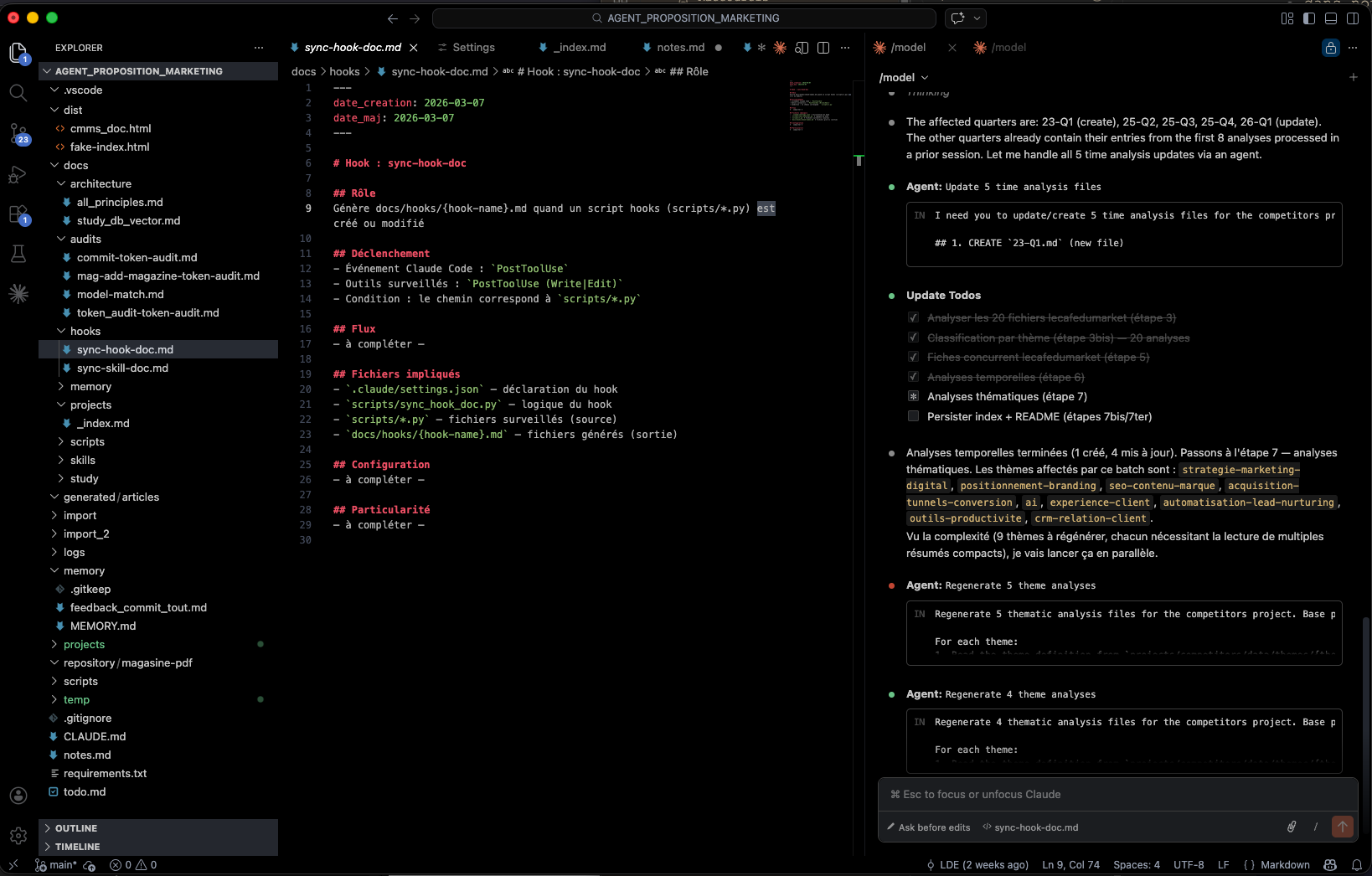
In eight days, I built a system able to do a large part of that tedious work for me. Gather the material. Organize it. Make it usable. Keep it up to date. And finally let me devote my energy to what really matters: analyzing, understanding, deciding.
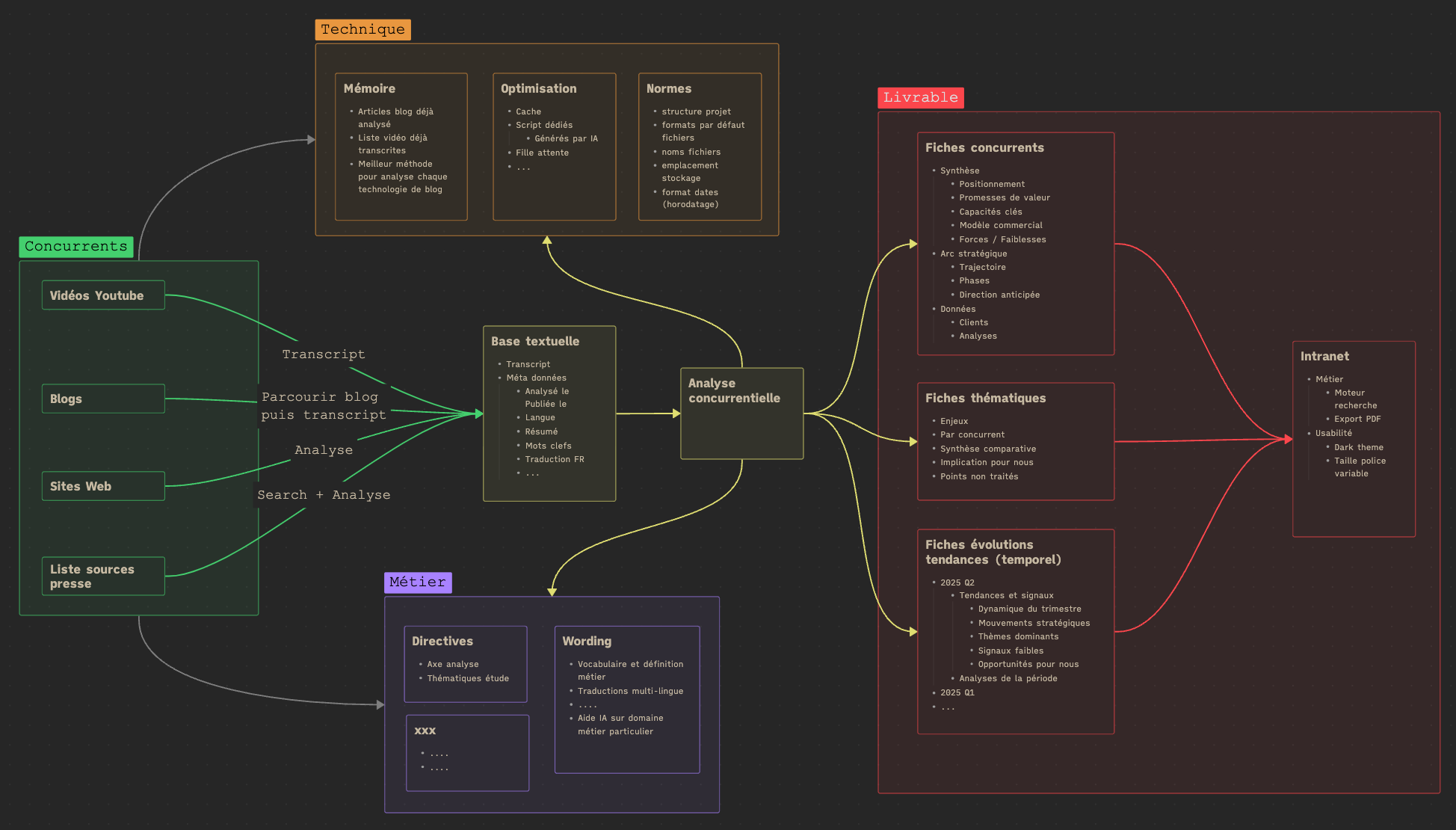
And that's when it hit me.
Because I realized the point wasn't just "saving time on competitive intelligence." The point was much broader. I'm looking, very concretely, for how to eliminate one by one all the time-consuming tasks that clutter my work. Everything that takes my time without directly helping me produce strategic clarity has become a target.
And in my eyes, that's exactly where the Product Manager job is shifting.
For a long time, the PM was a kind of hub. You had to gather needs, rephrase them, produce documents, clarify tickets, put things back in order, coordinate, prioritize, follow up, chase people, and document some more. Part of the job consisted in compensating for the organization's friction. You managed complexity, dependencies, ambiguities, constant translations between business, tech, design, support, and leadership.
It was useful. It still is. But I think we ended up accepting as normal an enormous mass of tasks that, deep down, weren't the core of the job — only its plumbing.
And today, that plumbing is starting to become something that can be automated, assisted, or radically accelerated.
That's the real change.
The Product Manager is no longer condemned to spend most of their time producing or maintaining intermediate artifacts. A growing share of that work can now be handled by tooled-up systems. Not perfectly. Not without oversight. But enough to change the equation.
So the question becomes blunt: if I can drastically reduce the time spent gathering, compiling, rephrasing, sorting, structuring, and maintaining, then what should I devote that reclaimed time to?
For me, the answer is simple: to strategy.
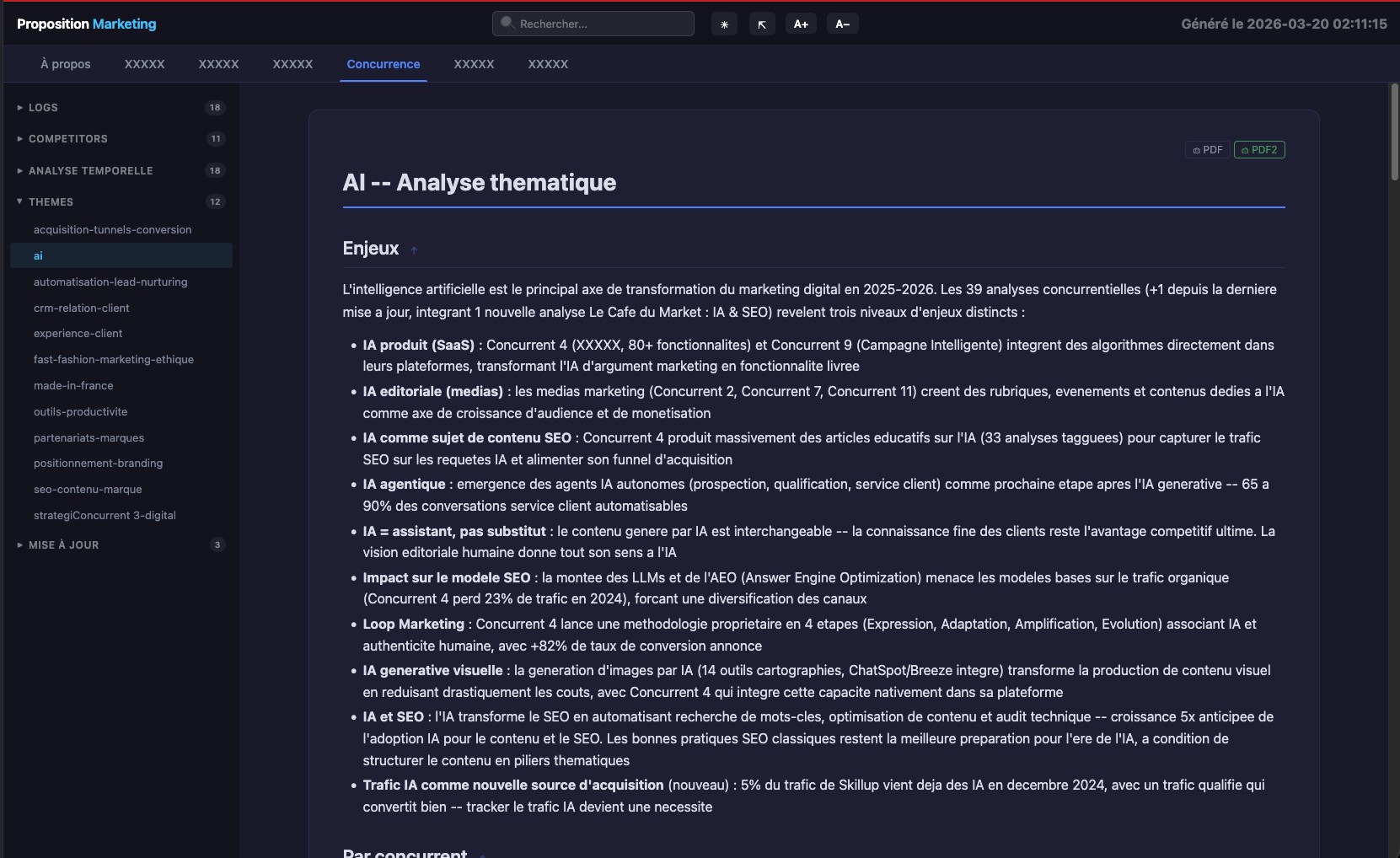
Not PowerPoint strategy. Not strategy as a catch-all word you pull out in meetings. I'm talking about real strategy: understanding where the market is going, what customers are saying without always knowing how to put it into words, which problems really deserve to be tackled, which trade-offs will create a real advantage, what positioning you want to defend, and where the company's energy should be focused.
That's where the value of the job rises back up.
Because at bottom, a good Product Manager isn't the one who produces the most tickets or the most docs. Nor is it the one who heroically holds up an inefficient organizational machine. A good PM is someone who sees clearly. Someone who understands what's changing. Someone who spots the right problem before everyone else. Someone who knows how to say no to ten appealing ideas in order to push a single one — but the right one.
Now, that quality of judgment demands time, depth, and mental availability.
And that is precisely what time-consuming tasks destroy.
When your days are eaten up by gathering information, reformatting, updating documents, following up on micro-topics, and managing operational friction, you no longer have enough space to think. You execute. You maintain. You absorb. But you no longer step back enough.
That's why I think the job is going to change completely.
Not because AI is going to "replace PMs." That reading is too simple and, in my opinion, not very interesting. The real point is that the center of gravity of the job is shifting. The value is shifting. The role is refocusing.
Less on producing intermediate material. More on understanding, direction, arbitration.
Of course, this doesn't make the tools magic. Claude Code can move fast, do a lot, sometimes brilliantly, sometimes get things badly wrong. You have to frame, proofread, test, supervise. Judgment is always required. Technical skill is always required somewhere. But even with those limits, what I saw in eight days seems unambiguous to me: the cost of many ancillary tasks is collapsing.
And when that cost collapses, there's really no longer any excuse to define the job solely by its operational layer.
Personally, that's exactly the direction I want to take: kill off as much as possible of everything repetitive, heavy, and scattering, in order to concentrate my time on what has the most value. Thinking about the market. Reading the signals. Understanding the dynamics. Choosing the battles. Building a direction.
So the real point isn't just productivity.
The real point is that we may be rediscovering what the Product Manager job should be, at its core: not managing the plumbing, but holding the course.