Originally written in French. Translated by AI — the meaning has been preserved, not the prose.
This article follows directly from my piece on "Flash Card". If you haven't read it yet, I'd recommend starting there. In it I explain what a pillar card is, what sets it apart from an atomic note, and why it has to stay rare. Here, I want to show how I keep those cards alive.
I had stopped keeping my cards alive
For several months, I had been using my card box less and less.
It wasn't a decision to abandon it. I hadn't concluded that the method no longer worked. I hadn't found a more effective system. I had simply been absorbed by something else: producing with artificial intelligence.
AI lets you produce at extraordinary speed. With tools like Claude Code, I can sometimes do four, five or ten times more than before. Every time a task speeds up, another one becomes possible. Then another. The time saved isn't freed up: it is immediately reinvested into more production, more checking, more confirmation.
I ended up producing almost without interruption.
And I gradually let go of what feeds that production: reading slowly, taking notes, letting an idea resist, returning to a conviction, producing nothing for a while and accepting that I don't yet know what I think of it.
The problem isn't that AI stops us from thinking. The problem is that it makes production so accessible that it becomes very easy never to stop and think.
You can hand it three fragments, ask "what do you make of this?", and get a coherent formulation within seconds. That's useful. I do it. But if the move becomes systematic, AI ends up serving as a cognitive crutch. It steps in before we have formulated the problem ourselves, tested the contradictions, or discovered the nuances.
AI multiplies what we are, but it doesn't automatically make us evolve.
If I stay intellectually at time N, it can amplify that state with spectacular power. But it doesn't guarantee my move to times N+1 and N+2. That evolution still takes time, curiosity, reading and personal work of confrontation.
That is exactly the time my pillar cards were meant to protect.
A tweet made an old card resonate
One weekend, with my computer switched off, I came across a tweet from Olivier Martineau:
"I keep telling students there are two ways to use AI: 1. have the AI do your work; 2. do better, learn and improve thanks to AI. The difference? If AI is enough to do the work you've been given, you don't have a job."
The idea immediately resonated with a card I had written long before ChatGPT, drawn from The Almanack of Naval Ravikant:
"Specific knowledge is knowledge that you cannot be trained for. If society can train you, it can train someone else and replace you."
A second sentence completed the idea:
"Specific knowledge cannot be taught, but it can be learned."
In Naval Ravikant's original formulation, the replacement is of one human by another human that society can train just as well. The tweet shifted the question sharply: if what I know how to do can be handed over entirely to an AI, what remains specific in my knowledge?
I went and fetched the card.
Then it called up others: cards on information, knowledge, experience, judgment, creativity, intellectual competence. I took them out of the box and laid them on the table.
I didn't have an answer yet. I only had a tension strong enough to make me want to think.
The table as a large thinking screen with no interface
I started moving the cards around.
One seemed to be the consequence of another. I put it on the right. Another introduced a condition; I placed it underneath. Two cards seemed to reinforce each other. A third created an opposition. I tried one arrangement, then another.
The layout was neither decorative nor prepared. It followed the thinking as it formed.
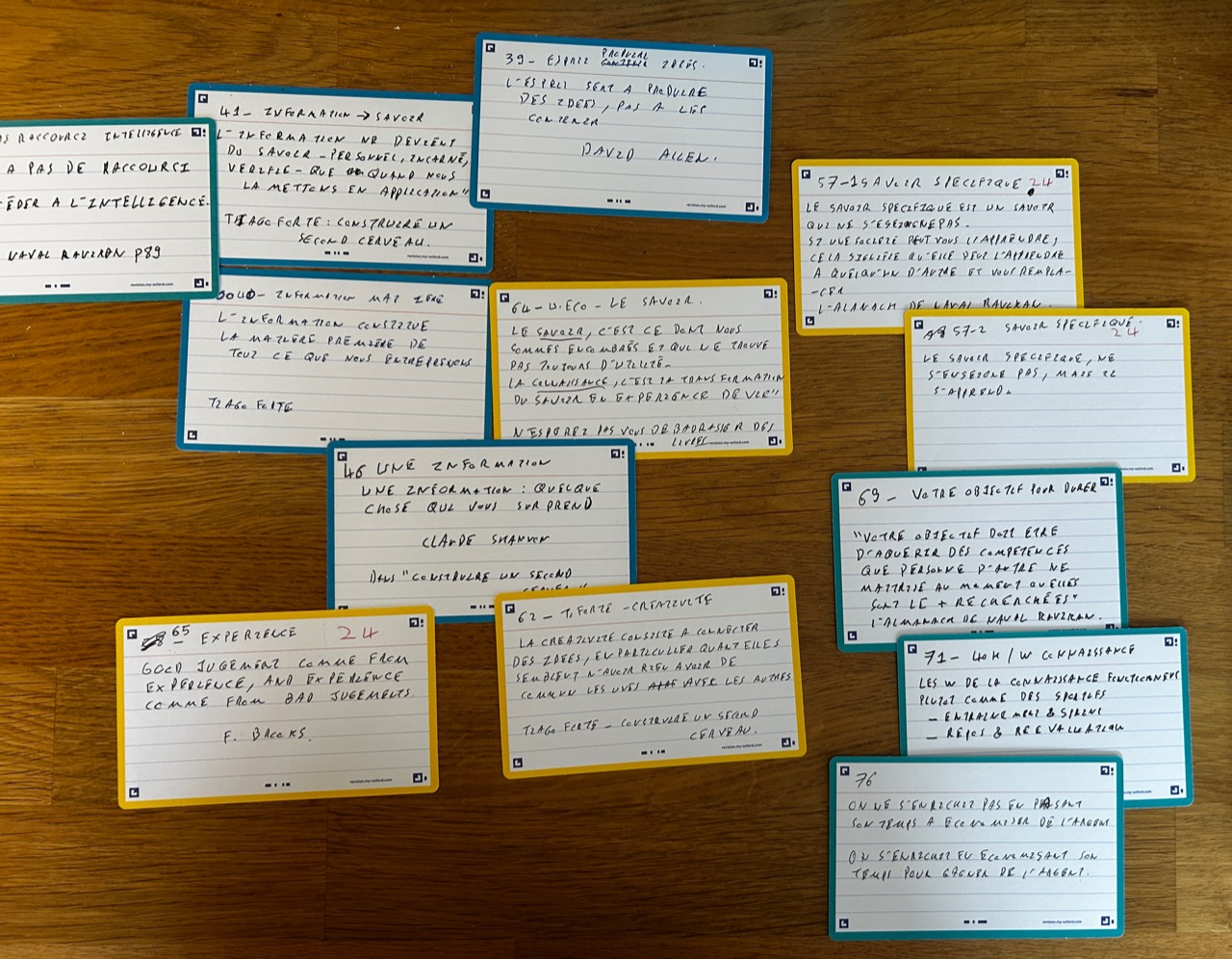
The colors carry no meaning here. The cards are grouped according to the relationships explored during the session.
I can link notes in Obsidian. I can build a graph in Miro. Those tools are very useful, but they put an interface between the gesture and the idea. To draw an arrow, you have to select a tool, choose its direction, sometimes adjust its appearance. To keep an overview, you have to zoom in and out. To move an element, you first have to select it.
On the table, I pick up a card and I move it. The gesture is enough.
All the cards stay visible at the same time. I can start from scratch instead of following the relationships already recorded in a piece of software. I can try a composition, destroy it in a second and start again somewhere else.
The table becomes a large thinking screen with no interface.
At that point the cards are no longer just memory supports. They form a setup for composing thought.
Confronting rather than confirming
The important word here is confrontation.
I don't take my cards out to have them confirm what I've just read. Nor am I trying to mechanically produce a broader thought than the original tweet. I confront that new proposition with my pillars: do I agree? Where does my disagreement begin? What has changed since the card was written? What nuance is missing?
Confrontation can strengthen a card. It can also weaken it, displace it, or reveal that it no longer holds.
A card doesn't actually need to contain an idea I agree with. Some propositions shake my certainties hard enough to deserve a place in the box. As long as I have no counter-argument that genuinely dismisses them, they stay active. Such a card becomes an unsettling pillar.
Excluding them would amount to organizing my knowledge so as never again to meet what contradicts me. That would be exactly the opposite of the goal.
Once the cards are laid out, I take their relationships into my notebook. I don't copy them. I draw arrows, dependencies, oppositions and groupings. The page brings something the cards didn't hold separately: a visual synthesis of the thinking produced during their confrontation.
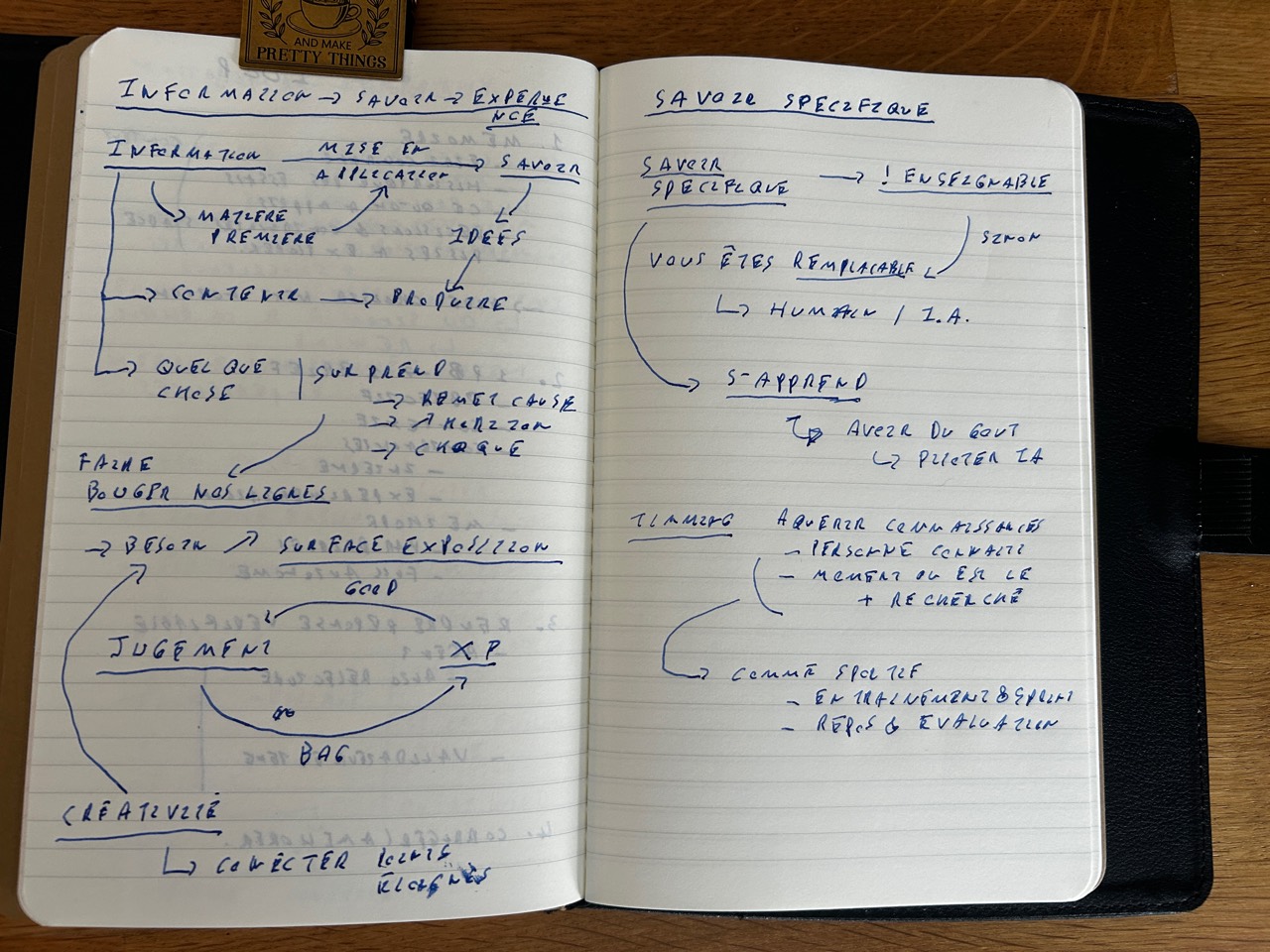
The notebook page doesn't summarize the cards: it shows how they hang together around the question of specific knowledge in the age of AI.
The Naval Ravikant card was not rewritten. Its quotation is unchanged. But the network of thought around it has evolved. A proposition formulated before generative AI has met a new situation. The notebook preserves that update.
The card carries the pillar. The notebook carries the composition produced around it.
To make a card resonate, you still have to hold it in you
That scene depends, though, on an earlier and less visible piece of work.
For the tweet to spontaneously recall the Naval Ravikant card, that card has to be present enough in my memory. A quotation stored somewhere in a note base doesn't necessarily produce that resonance. I can find it with a search, but I won't think to search for it if it hasn't already come back to me.
That is the first use of my pillar cards: maintaining a small number of anchor points through active recall and spaced repetition.
The Leitner box rests on a simple principle. Cards you barely master come back often. Those that become familiar are reviewed more and more rarely. The repetition spaces out as the memory becomes more persistent.
I'm not trying to apply that mechanism to the thousands of atomic notes, reading notes and sources I own. That would be impractical. My brain is not a RAG capable of scanning tens of thousands of fragments on demand.
I apply Leitner to a far smaller set: my pillars.
The logic draws on the Pareto principle. I concentrate the reactivation effort on a few cards capable of calling back a wider network. I'm not claiming that memorizing a root automatically memorizes the whole tree. But when that root stays accessible, it offers a path toward other ideas, other readings and other experiences associated with it.
I currently use three very loose levels:
- The idea is still poorly mastered. The card reminds me of something, but I can't yet unfold its consequences and its ins and outs. I review it roughly every two weeks.
- Mastery is intermediate. I can explain the idea and some of its implications, without having explored its full depth yet. I review it roughly every month.
- Mastery is deep. I can discuss it with nuance, confront it with a situation, or write an article on it directly. I review it roughly every two months.
Those intervals aren't hard rules. I'm not trying to industrialize my memory. Moving from one tray to the next doesn't reward a perfect recitation; it expresses a degree of appropriation.
The most important thing isn't the mechanics of the box. It's the link between the two uses: repetition keeps the pillars available; confrontation keeps them from setting.
A limited, living, incomplete deck
This practice only works if the cards stay rare.
An idea doesn't become a pillar because it's interesting, elegant or useful. It has to produce a far stronger anchoring. When I read it again, a few lines should be enough to bring back immediately what it opened up in me.
Otherwise, the box ends up reproducing the problem of the note base: hundreds, then thousands of items that exist somewhere but can no longer be actively maintained.
I've set myself a personal limit of two hundred cards. I currently own fewer than a hundred, because my entry criterion is demanding. There's nothing scientific about that limit. I drew in particular on Dunbar's number, often summarized as a limit on the number of stable social relationships a person can maintain.
I'm not transposing that result to the memory of ideas. Dunbar's number concerns social relationships, and its generalization into a single human number has itself been contested. All it gave me was an intuition: what we want to actively maintain probably has to stay bounded.
That borrowing illustrates the work of the cards, as it happens. Knowledge from one field can be moved, confronted with another problem and adapted to formulate a personal hypothesis. I'm not trying to prove that two hundred is the right number. I'm testing a constraint.
I don't yet know what will happen when I reach that limit. Will I have to delete more cards? Replace some? Merge them, at the risk of weakening their individual force? I don't have the answer.
What I do know is that a card must be able to die.
I have one on the product trio: the product manager, the developer and the designer as the core decision-making team. In the way I work, that card has aged badly. With AI, a developer can take on the scale of a team and move much closer to the business. The old frame no longer seems to carry the same reality.
The active deck isn't an archive of all my former convictions. If it no longer represents my current pillars, it loses its function.
Nor should it be filed by domain. The colors of my cards carry no meaning. I don't want an "AI" group, a "product" group or an "innovation" group. A card drawn from Karl Lagerfeld on confronting ideas can perfectly well meet a card about startups or artificial intelligence.
The relationships depend on the question at hand, not on the category of origin.
Paper composes, digital retrieves and protects
My system remains paper first.
I use cards in a format close to A7, large enough to hold a title and three to five lines, but too small to turn into mini reading notes. When it's a quotation, I note the author and the title of the work. I rarely note the page: with digital editions and variable pagination, a search inside the book finds the passage more easily.
I can write the number of another related card on the back. But I keep those relationships light. They flag an association already encountered; they don't decide every future composition.
Each card also has a mirror in Obsidian. It lets me search a quotation in full text, copy it without transcribing it, and keep a backup if my box is lost or damaged. The digital graph shows the links already established, but I barely use it to think. The table is precisely what lets me start from scratch.
When I'm away from home, I can capture an idea provisionally in Apple Notes, then copy it onto a card later. The original stays the physical card.
Paper composes, digital retrieves and protects.
The choice of materials matters fairly little in the end. I use Oxford cards and Moleskine notebooks because I'm looking for formats I'll plausibly still be able to buy in several years. These aren't requirements of the method. What matters is using cards of the same size, with durable commercial distribution, and constrained enough to stay brief.
Neither PARA nor Zettelkasten
Pillar cards don't replace my other knowledge management systems.
I still use PARA and Zettelkasten, for different purposes. I'll devote a series of articles to them, because both methods deserve better than a summary in a few paragraphs.
PARA is strongly oriented toward action. A project creates a need, then the available knowledge is mobilized to get a result. Zettelkasten leaves more room for emergence: readings become notes, notes enter into relation, and new ideas appear in the network.
Pillar cards occupy another place. They are neither a general base nor a project management method. They form a personal, limited core of ideas I want to keep active inside me.
When I lay them on a table, I'm not necessarily asking them to produce an article, a decision or a usable answer. I'm asking them to help me think through a tension that matters now. Something may come of it, but that isn't the obligation of the session.
Wanting to cash in on that thinking straight away would destroy part of its value. You have to keep the possibility of drifting, of meeting a contradiction, and of finishing with no deliverable but with a thought that has moved.
Recreating a time when you think alone
The main risk of this method isn't choosing the wrong box. It's no longer leaving it any time.
Slack, LinkedIn, daily requests and AI-assisted production easily keep you in a continuous flow. In that flow, curiosity erodes. You no longer read enough for an idea to stop you. You no longer give it time to resonate. The box then becomes a collection of dead quotations.
So I'm trying to reinstate a regular appointment, ideally an hour a week.
During that time, Slack is off. LinkedIn is off. The computer is off. So is ChatGPT.
I stay alone with the box, the cards, the notebook and whatever I'm able to make of them. I can't immediately ask an AI to interpret my fragments for me. I have to formulate, doubt, connect, contradict and sometimes admit that I don't yet know.
The session can start from a tweet, a reading, a conversation or a problem encountered during the week. I can set that element aside when it appears, then pick it up when I finally have the time.
If nothing imposes itself, I can also drift. I take a few cards at random. I read one, then another. An opposition appears. One card calls up a third. Resonance doesn't always precede the session; it can emerge from that free navigation.
This slow phase isn't a rejection of AI or nostalgia for paper. On the contrary, it prepares a better use of AI.
I now distinguish two times:
- slow consolidation, during which I read, handle, write and densify my thinking without AI;
- fast exploitation, during which I mobilize that thinking to steer the tools, produce, analyze or decide.
The speed of the second depends on the depth of the first. If I remove consolidation, I can keep producing more, but I risk endlessly amplifying only what I already knew.
Start with fifty cards and a pen
The surest way never to start would be to want the whole system in place immediately.
Don't buy three boxes. Don't define a taxonomy. Don't pick a color code. Don't build an Obsidian graph before you've written the first card.
Buy a pack of about fifty index cards and a pen. Choose a simple format, close to A7, that you'll easily be able to find again. Leave the cards visible on your desk.
Then wait until an idea really strikes you.
Not an idea that's merely interesting. Not a well-turned sentence you'll have forgotten the next day. An idea that sinks in, that organizes something, that clarifies things for you or unsettles you enough to stay open.
Write down a number, a title, then the idea or the quotation in a few lines.
Come back to the first cards from time to time. Ask yourself whether they really bring something back, whether they call up other knowledge, whether they still meet your experience. If the practice gives you something, you can buy a box, create a digital mirror and gradually introduce spaced repetition.
But start before you've designed the perfect system.
The goal isn't to manage all your knowledge. It's to make a few ideas present enough that they can meet, confront each other and keep transforming you.