Originally written in French. Translated by AI — the meaning has been preserved, not the prose.
In Lisbon, an opening ceremony largely turned toward China led me to ask a different question from that of technological leadership. Who chooses to show the future, who pays for that visibility, and what do countries gain from it? Going back to the origins of Web Summit reveals a market for influence far larger than a simple professional trade show.
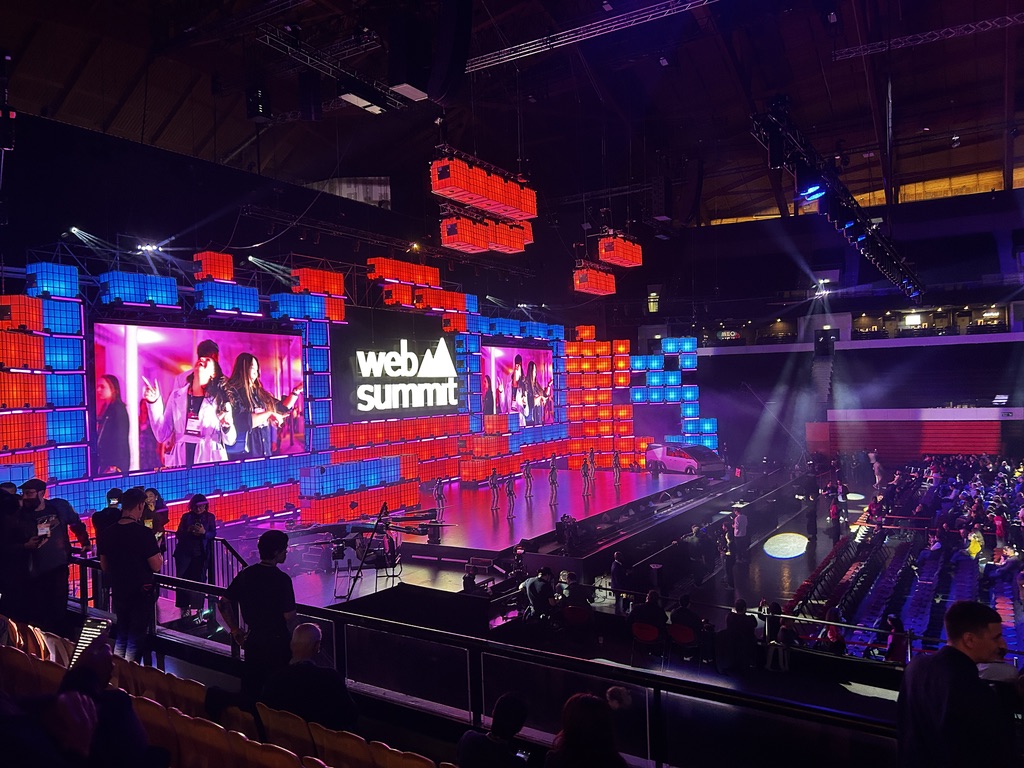
"It's no longer California, it's China"
On November 9, 2026, I attend the Web Summit opening ceremony in Lisbon. And something surprises me.
I expected to hear about artificial intelligence, startups, new products and, naturally, the American companies that have held center stage for years. All of that was there. But a large part of the speeches and the staging seemed to tell another story: to look at the future of technology, we would now have to turn our eyes to China rather than California.
Paddy Cosgrave, Web Summit's CEO, did not merely mention China's rise. He recalled that today's big tech companies were, for the most part, born in California, before declaring: "Increasingly, the superstars of tomorrow don't come from California. They come from China." A few moments later, he argued that Chinese companies were building our shared future more than those of any other country, adding: "This is just a fact." That was his claim, not an independent ranking of global innovation. Chinese companies and robots featured prominently in the evening. I felt a kind of imbalance, almost a staged competition between two powers: yesterday's America and tomorrow's China.
I wasn't shocked. I was intrigued.
Yet the same evening offered another narrative, almost as a counterpoint. Carlos Moedas, mayor of Lisbon, recalled that the city was built through contact between different cultures, languages and religions. He then told the audience: "No matter who you are, where you come from or what you believe, you belong here. You belong in Lisbon." Then he proposed a simple exercise: look at the person sitting next to you. They may speak another language, practice another religion and see the world differently. But they may also hold the solution to the problem you've been working on for years. His conclusion was clear: difference and diversity feed innovation.
A little later, the stage filled with founders from many countries, carrying their flags. The host named Singapore, Slovakia, South Africa, Paraguay, Pakistan and Palestine. About a hundred founders were invited on stage. Given the international context, the mention of Palestine did not escape me. But it appeared here in a list of origins and cannot be read as a position on the Israeli-Palestinian conflict.
Two visions therefore sat side by side during this opening: rivalry between technological powers, and the idea that innovation is born from meetings across borders. That contrast interested me as much as the place given to China.
Because what is put on a stage is never exactly what a sector contains. The ceremony also included Western players, notably Cloudflare and Lovable. And the symbolic place given to China does not mean Chinese companies were in the majority across the whole program (the Qatar and Brazil booths are a counterexample). The impression of an evening and the actual makeup of a trade show are two different things.
So the question is not whether, judging from a stage, China has already "won" the technology race. It is more interesting: who crafts the narrative of global technology, and why?
To answer, we need to understand what Web Summit has become. And, before that, where it comes from.
A story that doesn't begin in a ministry
Web Summit was not born from a grand plan for national influence. Its story begins in Dublin, in a fairly modest entrepreneurial community.
In 2009, Paddy Cosgrave organizes, among other things, a gathering called F.ounders. About 150 people attend. In 2010, the first structured editions of Web Summit draw a few hundred participants. The Irish entrepreneur, a graduate in economics and political science from Trinity College Dublin, does not come from the traditional trade fair industry. He is first interested in software, in organizing meetings and in using data to bring the right people together.
David Kelly and Daire Hickey later take part in building the company. Historical sources present them as co-founders, even though Cosgrave would later claim to be behind the very first initiative in 2009. That nuance matters: the story of the founding has itself become a subject of conflict.
What interests me most in the initial model is its real product. Of course, you go to a conference to hear speakers. But you come back to meet people.
From its very first conferences in Dublin, Paddy Cosgrave sets out to organize meetings between participants. In 2010, he already uses an algorithm designed with a statistician friend to assign about 200 guests to different tables. The principle is later extended to Web Summit, with apps recommending relevant contacts and tools to analyze professional networks. The goal is simple: increase the chances that the right people meet. Cosgrave describes these methods in a 2015 interview with WIRED: https://www.wired.com/story/scaling-dublin-summit/
This logic of organizing meetings is still visible in Lisbon in 2026. I noticed that the organizers had set up many WhatsApp groups, some by country — including one for the French — others by profession, such as those for product managers and marketing professionals. Participants could introduce themselves, exchange and set up appointments (the groups are in fact still active now that the show is over). It is a very concrete illustration of this drive to facilitate meetings, from the algorithmic seating plans of the early editions to today's discussion groups.
In other words, Web Summit doesn't just sell conferences. It organizes access to a global network of founders, executives, investors and decision-makers.
At that time, the goal is first entrepreneurial. But when a network reaches that scale, it naturally becomes interesting to other players. In particular, to states.
Lisbon: the moment the trade show becomes a matter of state
The big turning point comes in the mid-2010s. Web Summit has outgrown Dublin and is looking for a new home to continue its development. Several European cities put themselves forward. In 2015, Lisbon is chosen to host the 2016 to 2018 editions.
The organizers cite capacity, infrastructure, the startup environment and growth potential. But the story is also political and economic.
In September 2015, Portuguese tourism and investment promotion bodies conclude a cooperation protocol to bring the event to Lisbon. In 2016, the government creates a working group dedicated to Web Summit. It brings together the ministries, the economic agencies, Lisbon city hall and the private organizer.
A note from the economic department of the French embassy in Portugal, dated September 2018, states that the trade show then receives €1.3 million in annual support from Portuguese tourism and investment promotion bodies.
Then comes the new agreement for 2019-2028. An official communiqué of the Portuguese Council of Ministers from November 2018 authorizes up to €80 million in state spending commitments for hosting Web Summit. This does not mean €80 million was actually spent: it is a commitment ceiling, separate from any costs borne by other public bodies.
Why such an investment?
There are the hotels, restaurants, transport, visitors and immediate revenue. But that is only part of the equation. By hosting Web Summit for the long term, Lisbon also seeks to be recognized as a city where the technological future is being built, where companies can set up and where talent has reason to come and work.
Cosgrave himself staged this evolution at the 2026 ceremony. In his telling, in 2016 Lisbon was mocked as a destination for surfers and backpackers, with no real importance in tech. Ten years later, he explains, the international press would speak of Portugal as the "California of Europe" and of Lisbon as a European startup capital. He personally thanked former mayor Fernando Medina and current mayor Carlos Moedas. This change in reputation is precisely what a territory seeks through soft power. Cosgrave's speech is an illustration of it, not proof that Web Summit is its sole cause.
The trade show becomes a recurring showcase for national economic policy.
The announced benefits should nonetheless be examined with caution. An ex post evaluation covering 2016-2019 specifically sought to distinguish economic activity, startup trajectories and investment attraction. Initial projections were revised downward in the figures reported by the Portuguese press. An extra visitor is not automatically an established company, and a company that is present is not necessarily a lasting investment.
This strategy could also be heard in the words of Gonçalo Matias, Portugal's minister for State Reform. At the opening, he addressed the infrastructure AI requires: energy, computing capacity, connectivity and the position of undersea cables. He also defended sovereign clouds: knowing where data sits, which laws protect it and how to ensure service continuity. His speech went as far as the idea of an "agentic state" able to simplify administrative procedures. It was the statement of a governmental ambition, not a demonstration that such systems already work at scale. Web Summit here offered a platform for a national digital sovereignty policy.
The essential point lies elsewhere: Portugal didn't just buy days of exposure. It integrated Web Summit into its attractiveness strategy.
When a private trade show interests several countries
From there, the model goes beyond Lisbon. Web Summit expands its international presence: Rio de Janeiro hosts its first edition in 2023; Doha launches Web Summit Qatar in 2024; Vancouver joins the organizer's geography in 2025.
Local arrangements differ, but territories' interests look alike. Bringing thousands of people to the same place means attracting activity. Bringing those who fund, create and run tech companies also means opening doors for the longer term.
Qatar offers a particularly explicit example.
The country signed a five-year agreement to host Web Summit Qatar through 2028. The event is run through a permanent organization involving the Government Communications Office and public institutions. In Lisbon, the Startup Qatar pavilion does not just display a flag and a few innovations. It promotes setup conditions, funding and concrete procedures for companies that might establish themselves in the country.
In Lisbon, I noticed the scale and apparent quality of this pavilion. Weather disruptions (storm Charle forced Web Summit to close on the last day of my visit, the day I had planned to tour the Qatari and Brazilian pavilions) prevented me from talking with their representatives to report on them in detail. I therefore separate this visual impression from what official documents allow us to establish.
Qatar's ambition is openly stated: to make the country a gateway between the region's startups, international investors and new markets. It comes with financial schemes. In February 2026, the Qatar Investment Authority notably announced an extension of its venture capital fund program, with local presence requirements for some managers.
An announced commitment does not mean all the capital has been disbursed, and a promised office is not a lasting presence already measured. But the mechanism is clear: attract people, companies and funds and, if possible, get them to stay.
Brazil uses another formula. Its business support agencies, notably Sebrae and ApexBrasil, accompany startup delegations to Web Summit and extend the exposure through incubation and internationalization programs in Lisbon. The pavilion is then only a visible moment of work begun before the show and continued after it.
At the start of the ceremony, Cosgrave had offered a striking comparison: "There are more startups here from São Paulo than from Paris." He added that participants came from 164 countries and welcomed the rise of the Global South. These figures and this comparison are the ones announced by the organizer. They mainly show which narrative he chooses to promote: a global technology ecosystem whose visibility is no longer reserved for the traditionally dominant capitals.
Countries therefore don't all look for exactly the same thing. Some want to host the global gathering on their soil. Others want to present their companies there, attract capital or negotiate partnerships. Many combine these approaches.
China: technological visibility and economic diplomacy
Back to the ceremony that had intrigued me.
China is not represented only by a few impressive demonstrations. In 2026, Web Summit also hosted a China-EU Forum, devoted to technological and economic cooperation. The Portuguese agency AICEP reports the participation of its president Ana Casaca, of Paddy Cosgrave and of Chinese diplomatic and economic representatives.
Portuguese official communication stresses possible complementarities: robotics, artificial intelligence, advanced industry, European engineering and new cooperation.
This confirms that there is an institutional dimension to the Chinese presence. Web Summit is not only a place where Chinese companies come to rent booths: it can also host exchanges that belong to economic diplomacy.
The Chinese speakers also made directly commercial proposals. The representative of XPeng AeroHT, who came to present a flying vehicle project, explained he was looking for opportunities to develop his products in European and American markets. An AGIBOT executive, for his part, invited startups to join its partner ecosystem and build applications with its SDKs and APIs. Here is a less spectacular but essential dimension: the stage also serves to open markets, attract developers and build distribution networks. This documents a commercial intent, not yet the contracts that might result.
A delicate question remains: does this visibility stem from a sincere reading of technological change, from the trade show's commercial strategy, from a diplomatic intent, or from several factors at once?
Cosgrave publicly defends his choice to showcase China, arguing that it is gaining ground in major fields. Prospects for Web Summit expanding into China have also been mentioned. But nothing in the sources gathered allows us to claim that Lisbon's program was bought or imposed by Beijing, or that a future Chinese edition would be its counterpart.
Two ideas must be held together: China is indeed a technological power that cannot be ignored; and the choice to devote a stage, words and symbols to it is an editorial decision.
A trade show never shows the whole world. It offers a selection.
Who decides? The founder, the sponsors or the states?
This question raises another: who really owns Web Summit?
Paddy Cosgrave long held a large majority of the capital: 81%, against 12% for David Kelly and 7% for Daire Hickey. After a court dispute among the three former partners, settled out of court in 2025, he bought out the minority stakes. The accounts reported by The Irish Times indicate that he now controls 100% of the group.
Yet this concentration of capital is not synonymous with absolute independence.
In 2023, Cosgrave's statements on the war between Israel and Hamas triggered a controversy, the withdrawal of several major sponsors and his temporary resignation as CEO. He returned to the helm in April 2024. This brief episode shows that a company can have a dominant shareholder while remaining sensitive to the weight of its economic partners.
This does not mean sponsors dictate the content of each conference, or that host states decide who goes on stage.
We simply need to distinguish company ownership, the contracts that fund it, editorial decisions and the influence partners may exert. Only by separating these levels can we avoid reducing the subject to a grand narrative of manipulation, however seductive.
Soft power is also played out in invisible meetings
One might think influence is measured mostly by the size of pavilions, a minister's presence or an executive's speaking time. But Web Summit's history points to a less spectacular dimension.
The real asset of these events is their ability to bring together people who, without them, would not necessarily meet.
A startup leaves with a potential investor. An economic official discovers a company he would like to attract to his territory. A delegation publicizes its support program. An entrepreneur opens a subsidiary. A partnership takes shape.
Some of these exchanges will produce nothing. Others may have significant consequences, but several months later, far from the cameras. It would be misleading to present every meeting as a commercial success. It would be just as misleading to reduce the trade show to its public spectacle.
It is this combination of visibility, access to networks and opportunities to set up that makes tech conferences so interesting for companies and states alike.
The opening ceremony, incidentally, ended with a very simple gesture: the host asked participants to look left, then right, and get to know their neighbors. After the robots, the announcements and the big speeches, the final message brought everyone back to a possible meeting. It was a direct echo of Carlos Moedas's words on diversity: the person next to us may hold an answer we have been seeking for years.
A trade show is not an embassy. But it can offer part of what a country seeks through its economic diplomacy: to be visible, to be visited, to be associated with a positive image and to build lasting relationships.
Conclusion — Web Summit is only one piece on the chessboard
To understand these mechanisms, one last trap must be avoided: thinking everything plays out at Web Summit.
Other gatherings are part of the same global chessboard, with very different organizational models.
In Helsinki, Slush was born in 2008 from an entrepreneurial initiative. The organization is non-profit and belongs to the Finnish Startup Foundation. The city of Helsinki partners with it to strengthen its attractiveness, without owning the event. It is soft power that first emerges from a community, before being leveraged by the territory.
In Dubai, GITEX Global follows a logic more directly tied to public economic strategy. Its organizer, Dubai World Trade Centre, is a body historically attached to the emirate. The transformation announced for 2026 with GITEX TechCation explicitly combines technology, investment, tourism and culture. Dubai uses the event to reinforce its position as an international destination for business and innovation.
In Riyadh, LEAP relies on Tahaluf, a joint venture bringing together the international events group Informa, the Saudi federation SAFCSP and the Events Investment Fund. The Saudi Ministry of Communications and Information Technology is among the show's founding partners. Here, international commercial expertise is combined with national priorities of attractiveness and economic diversification.
Not to mention the famous CES in Las Vegas, or VivaTech...
And then there is Web Summit, a private Irish company that began by bringing entrepreneurs together and now provides several cities with a global platform for visibility and meetings.
These models are not identical. They don't give states the same power, and their benefits are not measured with the same indicators. They do share one thing: they create places where companies, capital, executives and governments can meet, present themselves and try to bend the course of events.
The next time an executive explains on stage where the future of technology will come from, I will probably listen with just as much interest. But I will also look at what surrounds them: who organizes the event, who funds it, why it takes place here rather than elsewhere, and which countries are trying to strengthen their presence there.
To understand technological soft power, we need to look at the whole chessboard. Not just the best-lit piece.
Main documentary sources
The references below distinguish firsthand sources, public texts and reporting. URLs are written out in full so they can be copied.
- Opening ceremony of November 9, 2026.
- Web Summit, official program of the opening evening, November 9, 2026: https://websummit.com/schedule/date/2026-11-09/
- WIRED UK, interview with Paddy Cosgrave on the origins of Web Summit and network engineering: https://www.wired.com/story/scaling-dublin-summit/
- ECO News, biographical interview with Paddy Cosgrave and the Lisbon decision: https://econews.pt/Interview/paddy-cosgrave-id-be-happy-to-do-the-web-summit-for-the-rest-of-my-life/
- French Embassy in Portugal, economic note of September 2018, initial support and Lisbon's strategy: https://www.tresor.economie.gouv.fr/Articles/3459bfcd-3aad-4f0c-af1a-feed250064bf/files/644ff75b-4ef8-419c-b870-60e96413cb8a
- Portuguese official gazette, Web Summit 2016–2018 working group: https://files.diariodarepublica.pt/2s/2016/06/123000000/2015020151.pdf
- Portuguese government, Council of Ministers of November 8, 2018, 2019–2028 agreement: https://portugal.gov.pt/gc21/governo/comunicados-do-conselho-de-ministros/235
- PLANAPP, ex post evaluation of the impact of Web Summit 2016–2019, study fact sheet: https://www.planapp.gov.pt/estudos-avaliacao/avaliacao-do-impacto-da-web-summit/
- ECO, limits of the initial economic projections, November 3, 2021: https://eco.sapo.pt/2021/11/03/impacto-da-web-summit-mais-do-que-justifica-o-investimento-do-governo/
- Qatar Government Communications Office, official delegation and Startup Qatar pavilion in Lisbon, November 4, 2026: https://www.gco.gov.qa/en/media-centre/top-news/qatar-returns-to-web-summit-lisbon-for-fourth-consecutive-year/
- Qatar Government Communications Office, strategic partnership with Web Summit: https://www.gco.gov.qa/en/about-the-gco/strategic-partnerships/
- AICEP, China–EU Forum at Web Summit 2026: https://www.portugalglobal.pt/pt/noticias/2026/novembro/portugal-reforca-pontes-entre-a-china-e-a-europa/
- Observador, interview with Paddy Cosgrave on China and the future of Lisbon, November 5, 2026: https://observador.pt/2026/11/05/paddy-cosgrave-diz-que-ha-boas-conversas-sobre-o-futuro-da-web-summit-em-lisboa-mas-2029-ainda-esta-muito-longe/
- The Irish Times, capital control and Web Summit accounts, November 2025: https://www.irishtimes.com/business/2025/11/27/web-summit-back-in-profit-after-paddy-cosgraves-return-as-ceo/
- RTÉ, settlement of the dispute between former partners, March 2025: https://www.rte.ie/news/courts/2025/0327/1504339-web-summit-case/
- Sebrae, incubation program for Brazilian startups in Lisbon, 2026: https://agenciasebrae.com.br/inovacao-e-tecnologia/sebrae-e-apexbrasil-anunciam-20-startups-para-incubacao-em-lisboa/
- Slush, overview and non-profit governance: https://slush.org/about-us
- City of Helsinki, partnership with Slush: https://www.hel.fi/en/business-and-work/slush
- City of Helsinki, Slush 2025–2027 partnership decision: https://paatokset.hel.fi/en/case/hel-2025-011046?decision=524e9e27-3aab-4e62-baa8-8c4a6e4c0cb9
- Emirate of Dubai, Law No. 10 of 2008 establishing the DWTC: https://dlp.dubai.gov.ae/Legislation%20Reference/2008/Law%2010%20of%202008.html
- Government of Dubai Media Office, GITEX TechCation 2026 strategy: https://www.mediaoffice.ae/en/news/2025/october/16-10/mohammed-bin-rashid-directs-that-gitex-tech-cation-2026-be-the-world-largest-event-in-tech-and-ai
- LEAP, official fact sheet on the event and its founders: https://onegiantleap.com/about-us/key-information
- Tahaluf, official fact sheet on the joint venture: https://tahaluf.com/key-information